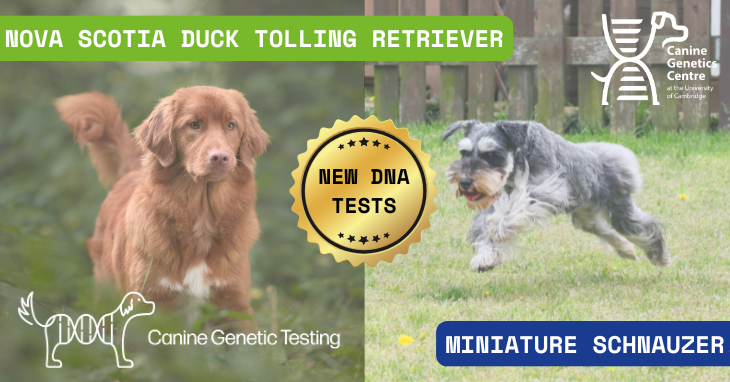
We are very excited to announce that earlier this week we launched not one, but TWO new tests for progressive retinal atrophy (PRA) in two different breeds – the Nova Scotia Duck Tolling Retriever (NSDTR) and the Miniature Schnauzer (MS).
Dr. Katherine Stanbury, our lead researcher on our inherited eye disease programme (CRIEDD), and Ellen Schofield, our Bioinformatician, used whole-genome sequencing (WGS) to analyse data from affected and unaffected dogs to find these new mutations. Both mutations are located on the X chromosome and are, therefore, referred to as X-linked diseases. Females require two copies of the variant to be affected with this form of PRA, whereas in males, a single copy will mean they are affected. Females that carry a single copy of the variant (known as carriers or heterozygotes) will not develop this form of the the disease, but they will pass the variant onto about half of any offspring they have. Half the boys bred from a carrier dam will be affected and therefore, we suggest NOT breeding from any carrier or affected dogs.
A scientific paper is being prepared to be submitted to a peer-reviewed journal that will detail these findings, and DNA tests based on these newly identified variants is available from Canine Genetic Testing (CAGT), the University of Cambridge’s own canine genetics testing service.