
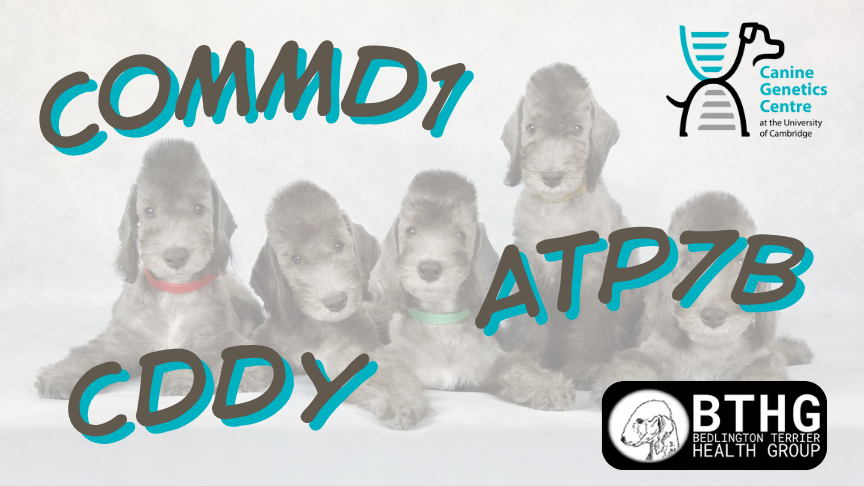
If so, we need your help with research into a possible new genetic cause of copper storage disease in the breed. And at the same time we will gain a better understanding of the frequency of a genetic risk factor for intervertebral disc disease (IVDD).
Copper Storage Disease
Researchers from the Canine Genetics Centre and Cambridge University (Dr Cathryn Mellersh and Dr Penny Watson) are working with Dr Susan Haywood to increase understanding of the genetics of copper storage disease (= copper toxicosis) in Bedlington terriers in the UK and would like your help.
In recent years, Drs Watson and Haywood have observed that some Bedlington terriers are developing chronic hepatitis due to copper build up in the liver but do not have the COMMD1 gene deletion which has been tested for in the breed for many years. The COMMD1 deletion is still found in Bedlington terriers in the UK, albeit much less frequently than previously (Haywood et al., 2023).
We have now identified another gene of interest, ATP7B, which is known to cause copper accumulation in humans and in some other dog breeds. We have already found this variant in a small number of Bedlington terriers with copper disease, and we now want to find out how common it is in the wider UK population (Haywood et al., 2023).
We have funding to DNA‑test 95 UK Bedlington terriers for both the ATP7B variant and the COMMD1 deletion. To get a representative sample, we are looking for male and female dogs living in the UK, of breeding age, and as unrelated to each other as possible.
Intervertebral Disc Disease
Recent data indicates that some Bedlington Terriers from Europe carry the genetic variant known as CDDY, which increases a dog’s risk of developing intervertebral disc disease (IVDD). We will therefore also genotype the 95 dogs for the CDDY variant at the same time as we genotype them for COMMD1 And ATP7B variants, with funding for this being generously provided by the Bedlington Terrier Heath Group.
How to get involved?
Testing is free, and owners will receive their dog’s results confidentially, along with advice if their dog carries one or two copies of either variant. Once all testing is complete, we will publish a summary of the overall findings, but individual dogs will not be identifiable.
All DNA samples will be processed together, so results will take some time.
Breed Health Coordinator Sheila Baldwin is coordinating the study. If you would like to take part, complete the form below, which will be e-mailed directly to Sheila.
You may submit more than one dog, but we are unlikely to select multiple dogs from the same litter. Once Sheila has a list of around 100 dogs, it will be reviewed by the Canine Genetics Centre, who will select the final 95 based on how unrelated they are.
If your dog is chosen, you will be notified and asked to provide your postal and email addresses so that we can send you a DNA collection kit and further instructions.
Comments are closed