
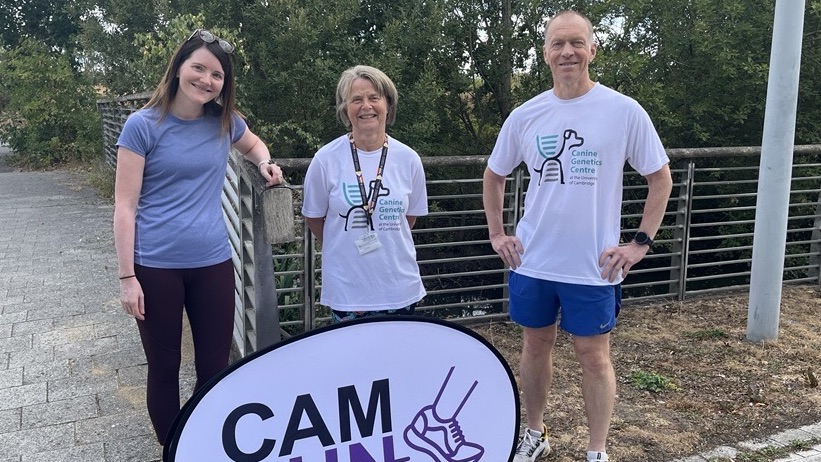
Staff at the Canine Genetics Centre (CGC) and the Queen’s Veterinary School Hospital (QVSH) are swapping lab coats and vet scrubs for running shoes in September to take on the London Big Relay and raise funds for our research into sudden death in young Labrador Retrievers. They will be joined by Joanna and Harrison Whyton, mother and son, whose eight-month-old dog Taitti sadly died of the condition in December 2025.
On Sunday 6 September, eight runners in two teams will make their way from Tower Bridge to Greenwich, each covering a leg of around 5 km in support of research into Labrador Retriever Sudden Death.
The teams have already raised more than £1,200, with race day fast approaching. Runners have shared stories of training and tired legs, and compared notes on who has volunteered for the hardest leg, but behind it all is a very serious purpose.
Labrador Retriever Sudden Death typically affects young dogs, often at around a year of age. They die suddenly and unexpectedly, usually while asleep.
“It’s such a shocking condition because these are young, apparently healthy dogs,” said Cathryn Mellersh, Assistant Research Professor and Group Leader at the CGC. “Families can put their young dog to bed as normal and then discover the next morning that they’ve died in their sleep. We are working to understand what is happening and, ultimately, to help save the lives of young Labradors and prevent other families from going through this traumatic experience.”
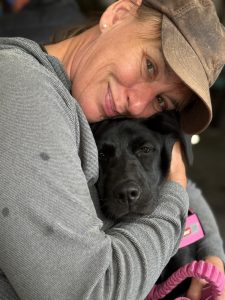
Joanna with Taitti, who died suddenly at eight months old.
For Joanna and Harrison, the challenge has a very personal significance.
“Taitti is never far from my thoughts,” said Joanna. “I just need some answers and more research is the only way I will get closure to all this. I’m lucky I have Bolli, who is 6, and my new pup Lanson, who is 6.5 months. It’s sad as I know that he would have adored Taitti, but unfortunately it was her time to leave us.”
Training has had its challenges too.
“It’s been so hot that we’ve both had to cut back on our training sessions,” Joanna added. “I’ve completed most of my training on a treadmill!”
“Having Joanna and Harrison running with us brings home exactly why we’re doing this,” said Jim Johnson, the team’s organiser and a Research Assistant at the CGC. “We’ll all enjoy the event, I’m sure, but what really matters is raising money to help us understand why this is happening. Every pound we raise will go directly towards that research.”
The research team is collecting DNA samples and detailed clinical information from affected dogs and their relatives. Funds raised through the relay will support the next stages of the project, including genetic analyses to search for variants that may contribute to the condition.
“We are working closely with the CGC to identify the genetic cause of this condition,” said Jose Novo Matos, Professor of Small Animal Cardiology and Principal Clinical Cardiologist at the QVSH. “The involvement of families affected by this condition is incredibly important to the research. We are especially grateful to people like Joanna and Harrison, who have chosen to help us after the tragic loss of their dog.”
That leaves the small matter of getting eight runners across London. With a mix of regular runners and those stepping outside their usual comfort zone, the relay will test everyone in different ways. The recent hot weather hasn’t made preparations any easier, but the team is hoping that enthusiasm and some well-timed handovers will get both teams all the way from Tower Bridge to the Cutty Sark.
The team will be sharing training updates and introducing the runners in the run-up to the event. All sponsorship raised through the JustGiving campaign will be allocated by the University of Cambridge to the Canine Genetics Centre’s Labrador Retriever Sudden Death research programme.
Please support our relay
You can follow the team’s progress and support the research through our JustGiving page:
Support our Labrador Retriever Sudden Death research on JustGiving
The London Big Relay takes place on Sunday 6 September 2026.
Comments are closed