
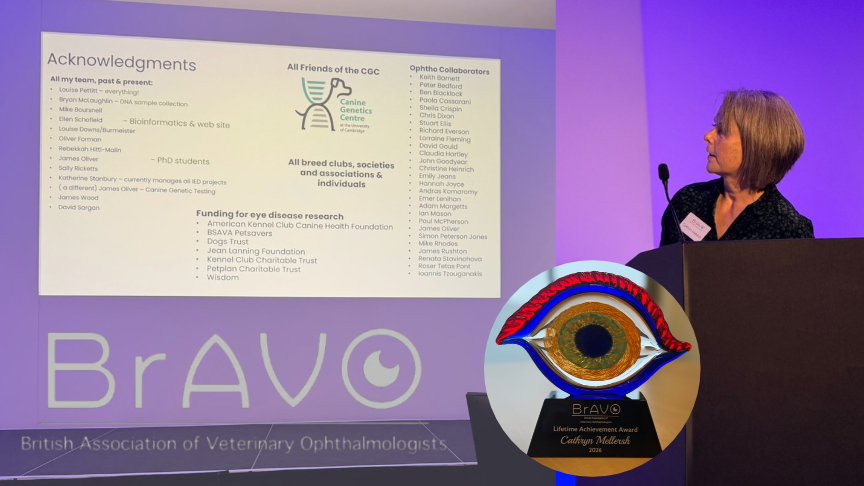
At their recent Winter Meeting, the British Association of Veterinary Ophthalmologists (BrAVO) awarded Cathryn Mellersh with their 2026 Lifetime Achievement Award, for “her outstanding and enduring contribution to veterinary ophthalmology and canine eye health“.
This award honours individuals who have made sustained, career-long contributions to the field of veterinary ophthalmology through clinical excellence, research, teaching, or service to the profession, and as the 2026 recipient, Cathryn was invited to deliver a keynote speech during the Saturday of the meeting. Entitled “From Microsatellites to Megabases: The evolution of genetic resources and their impact on inherited eye disease research in dogs“, Cathryn’s talk detailed her long career in canine genetics, from her early work during her first postdoc identifying some of the first markers in the canine genome, to her current work using whole-genome sequencing (WGS) to directly find specific causal mutations. She also touched on our future directions, moving into a time where we can use WGS as a diagnostic tool to obtain molecular diagnosis for individual patients.
Receiving the award, as a non-clinical researcher is truly incredible and speaks volumes about Cathryn’s dedication to her work as well as the close relationship she has built with clinicians in the Veterinary Ophthalmology field. Attending the conference enabled her to spend time with the very people that have supported the CGC through thick and thin over the years, and we are very grateful to them, and BrAVO itself for the support over the years, especially when we lost our main funding source back in 2022.
In their conference booklet, BrAVO wrote these kind words about Cathryn:
 “Cathryn’s remarkable career exemplifies the profound impact of scientific discovery, One Health collaboration and a commitment to animal welfare. Her pioneering research has not only advanced our understanding of inherited eye diseases but has also provided practical tools to help reduce their prevalence in future generations of dogs.”

Comments are closed